


Break the Ice! NVIDIA Resumes H200 Production for China
At the annual GTC held in San Jose, California on March 17, 2026, Nvidia CEO Jensen Huang announced that the company has received purchase orders from Chinese customers and is "restarting production" of the H200 AI accelerator specifically for the China market. Huang confirmed to CNBC that Nvidia has secured the necessary export license from the U.S. government, stating, "Our supply chain is now operating at full capacity."
Policy Easing and Implementation Challenges
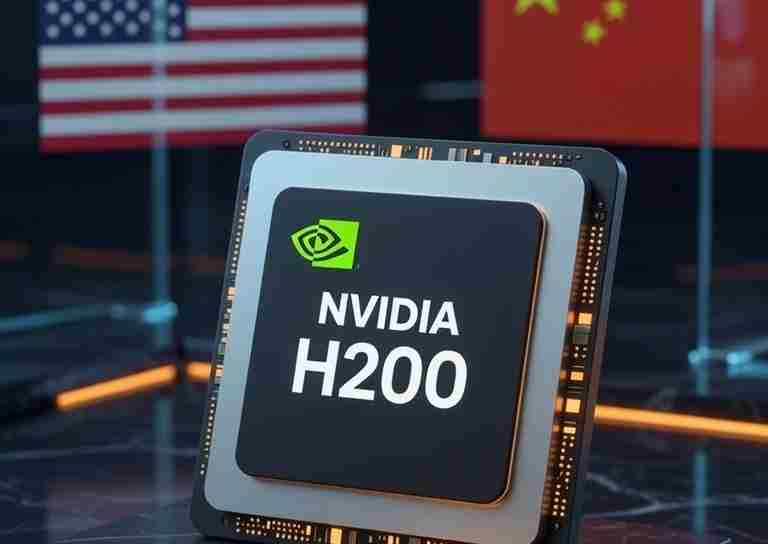 This resumption stems from a policy adjustment in December 2025. The Trump administration approved Nvidia's export of H200 chips to licensed Chinese customers, but imposed stringent conditions: the U.S. government will extract 25% of sales revenue as a "national security dividend," and exports are limited to older chip versions that have been on the market for approximately 18 months. More advanced architectures, including Blackwell and Rubin, remain explicitly excluded from the licensing scope.
Despite the regulatory green light, actual implementation still faces hurdles. The H200 chip, based on the Hopper architecture released in 2023, began global shipments in spring 2024. As of February 2026, Nvidia CFO Colette Kress acknowledged at an earnings conference that although the company received approval for "limited H200 products" to be sold to China, "we have not yet generated any related revenue," adding uncertainty about whether China will allow imports.
Reshaped Market Competition
The China market once accounted for one-fifth of Nvidia's data center revenue, but its share has since shrunk dramatically. During Nvidia's restricted period, domestic Chinese chipmakers—including Huawei Ascend, Cambricon, and Biren Technology—have rapidly emerged, while in-house chips from Alibaba's T-Head and Baidu's Kunlun Core have also reached mass production. Even with H200's potential return, Chinese customers may adopt diversified sourcing strategies, shifting from passive acceptance to selective procurement, potentially facing requirements to "purchase a certain proportion of domestic chips alongside imports."
Groq Chips: An Alternative Path to China
Meanwhile, Nvidia is preparing to launch AI inference chips based on Groq technology for the Chinese market. This chip stems from technology acquired through Nvidia's approximately $17 billion acquisition of Groq in late 2025, with market availability expected as early as May 2026. Sources emphasize that this version is not a performance-downgraded variant nor specifically customized for China, but can operate independently and adapt to other systems. The Groq chip focuses on AI inference tasks, creating a differentiated positioning alongside the H200.
CONEVO: Your Electronic Components Partner
CONEVO is a wholesale distributor specializing in integrated circuits and power management solutions. The Conevo has an extensive inventory covering microcontrollers, storage modules, processors, and specialized integrated circuits, among others. Conevo provides customers with appropriate procurement solutions, rapid delivery capabilities, and BOM requirements services. Here are the popular electronic components of Conevo today.
IC Model | Manufacturer | Key Features | Applications |
Maxim Integrated | Half-duplex operation, 250kbps data rate, low-power shutdown mode, failsafe receiver for open/short/terminated lines | Industrial automation, HVAC systems, motor control, point-of-sale terminals, building automation networks | |
Texas Instruments | ±50mV input range, 5MHz signal bandwidth, 5000Vrms isolation rating, integrated DC/DC converter, low drift | Motor drives, photovoltaic inverters, uninterruptible power supplies, isolated voltage measurement, industrial robotics | |
STMicroelectronics | 72MHz max frequency, 64KB Flash, 12KB SRAM, high-resolution timer (217ps), advanced motor control peripherals, USB 2.0 FS | Digital power supplies, lighting control, motor control, energy harvesting systems, power factor correction |
Website: www.conevoelec.com
Email: info@conevoelec.com


