


Selection Guide: In-Depth Analysis of Voltage Reference ICs
Voltage Reference ICs serve as the cornerstone of precision analog circuits, maintaining highly stable output voltages despite variations in input voltage, load current, and ambient temperature. Compared with Zener diodes or conventional voltage regulators, reference ICs deliver orders-of-magnitude superiority in accuracy, temperature drift, and noise performance—directly determining the effective resolution of ADC and DAC systems.
Modern voltage references primarily rely on bandgap architecture for temperature compensation. In 1971, Robert Widlar proposed utilizing two transistors with differing emitter areas to generate a positive temperature coefficient voltage, offsetting the negative temperature coefficient of base-emitter junction voltage (approximately -2 mV/°C) to produce a near-zero temperature drift output. This principle remains the design foundation for the vast majority of precision reference ICs today.
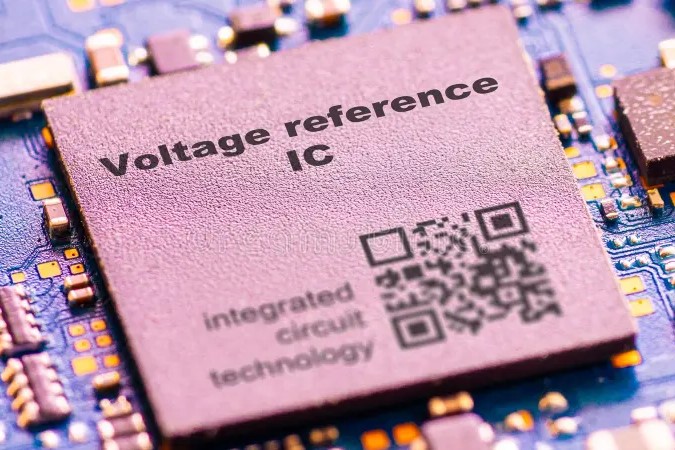
Series and Shunt Voltage Reference ICs
Voltage references are classified into two topologies: series and shunt, with selection tightly coupled to the power supply characteristics of the target application.
Series references employ a three-terminal structure (input, output, ground) with an integrated pass transistor, offering low quiescent current, high power supply rejection ratio (PSRR), and shutdown capability—making them ideal for battery-powered and low-power designs. Their dropout voltage can be as low as 200 mV, though the input voltage must exceed the sum of output voltage and dropout headroom.
Shunt references functionally equate to precision Zener diodes, requiring only an external current-limiting resistor for operation. Their flexible topology supports input voltages up to 40 V. Advantages include wide voltage adaptability and minimal pin count; however, quiescent current scales with input voltage, yielding inferior overall power efficiency compared with series types. The classic TL431 serves as the archetypal adjustable shunt reference, with programmable output from 2.5 V to 36 V.
Key Performance Parameters for Selection
When selecting a Voltage Reference IC, the following core parameters require comprehensive evaluation:
1. Initial Accuracy: The deviation between actual output voltage and nominal value at device shipment. High-precision applications typically demand ±0.1% or better.
2. Temperature Coefficient (TC): The critical metric measuring a reference's thermal resilience, expressed in ppm/°C. In wide-temperature environments such as automotive electronics or industrial field applications, ultra-low drift ensures consistent system performance across seasonal extremes.
3. Output Noise: Particularly low-frequency noise in the 0.1 Hz to 10 Hz band (1/f noise). For precision medical instruments or high-resolution data acquisition systems, even microvolt-level noise can obscure genuine weak signals.
4. Thermal Hysteresis and Load Regulation: The former denotes residual output voltage deviation after temperature cycling. The latter reflects output fluctuation induced by load current variation.
Popular Classic Voltage Reference Series
Part Number | Mfr | Type | Output Voltage | Initial Accuracy | Temp Drift (ppm/°C) | Noise (μVpp) | Core Features |
TI/Multiple | Shunt Adjustable | 2.5–36 V | ±1% | 20–100 | — | Ultra-low cost, power-supply feedback staple, 0.2 Ω dynamic impedance | |
TI | Shunt Fixed | 2.048/2.5/4.096/5.0 V | ±0.1%–1% | 20–100 | — | Micropower from 60 μA, SOT-23 package, ADC common reference | |
TI | Series Fixed | 2.5 V | ±0.05% | 3 | 3 | High-precision low-noise, 10 mA drive, industrial DAQ standard | |
ADI | Series Fixed | 2.5 V | ±0.02% | 2 | 1.25 | Ultra-low noise, high PSRR, precision instrumentation and medical electronics | |
ADI | Series Fixed | 2.5 V | ±0.1% | 1.5 | 0.5 | Sub-ppm drift, extremely low noise, high-end metrology calibration source | |
Maxim | Shunt Active | 1.25/2.5/5.0 V | ±1.5% | 50 | — | Active Zener architecture, load range 100 μA–50 mA | |
TI | Series Fixed | 2.5 V | ±0.1% | 6 | 4.5 | Micropower 25 μA, compact SC70 package, portable IoT sensing |
Application Scenarios and Selection Strategy
In data conversion systems, the reference voltage directly defines the ADC full-scale range. For a 12-bit ADC with a 5 V reference, 1 LSB corresponds to 1.22 mV. For a 5 mV reference drift would introduce approximately 0.1% system offset error. Consequently, 16-bit and higher-precision ADCs typically require external references to circumvent the elevated noise and temperature drift of on-chip references.
Low-power IoT sensor nodes should employ series references with quiescent current below 1 μA, leveraging shutdown modes to extend battery life. Industrial automation and automotive electronics demand guaranteed drift specifications across the -40°C to 125°C wide temperature range, with AEC-Q100 automotive qualification serving as a mandatory threshold. For laboratory calibration equipment, ultra-stable buried-Zener references such as the LTZ1000 achieve sub-ppm long-term stability, albeit requiring operation with thermostatic baths.
Website: www.conevoelec.com
Email: info@conevoelec.com


