


Kioxia Expands Northward with New High-End NAND Fab
Japanese memory giant Kioxia has announced plans to invest over ¥1 trillion to construct a third wafer fabrication plant at its production complex in Kitakami, Iwate Prefecture, northern Japan. The move is aimed at addressing the surging demand for storage chips driven by the artificial intelligence boom.
Third Fab in Kitakami
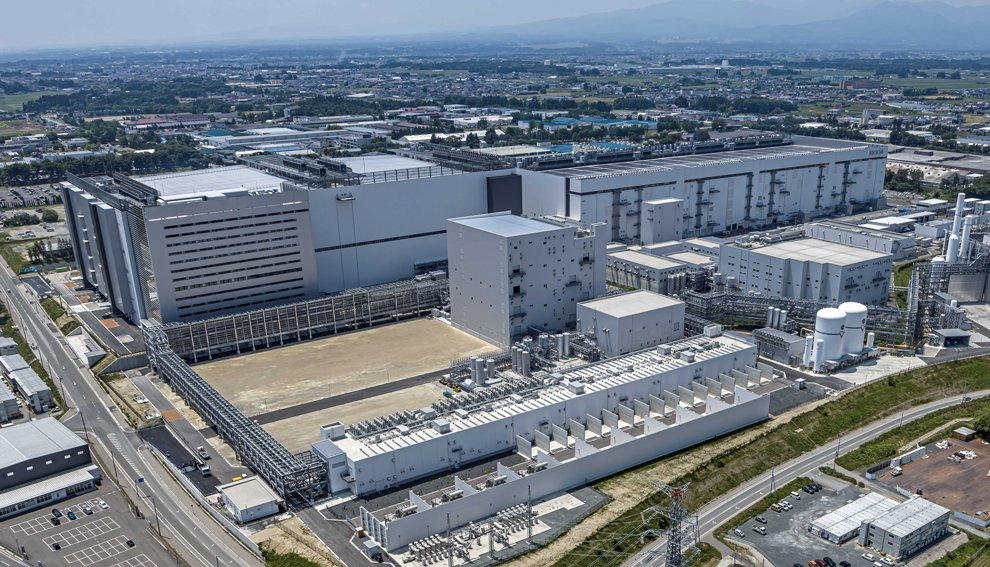 The planned facility, designated K3, will mark the third wafer fab at Kioxia's Kitakami site and will be jointly developed with the company's long-standing manufacturing partner, SanDisk. Scheduled to begin gradual production ramp-up after 2029, the new plant will be dedicated to manufacturing high-end NAND flash memory chips tailored for AI data centers. In contrast, Kioxia's other major production hub in Yokkaichi, Mie Prefecture, will continue to focus on consumer-grade products such as chips for smartphones.
The new fab will serve as the mass-production base for Kioxia's most advanced memory technology. In July 2026, Kioxia initiated customer sampling of its tenth-generation BiCS FLASH 3D NAND, which features a 332-layer stacked architecture. Compared with the eighth-generation product, the new chip delivers approximately 59% higher storage density, achieves interface speeds of 4.8 Gbps, and reduces output power consumption by 34%. According to TechInsights, global data center flash memory demand is projected to surge from 295 exabytes (EB) in 2025 to 1,807 EB by 2028, with AI inference-related demand growing at a compound annual rate of 86%. Kioxia’s production capacity for 2026 has already been fully booked.
Government-Industry Collaboration
Kioxia and SanDisk intend to apply for subsidies from the Japanese government for the new fab project. Senior executives from both companies formally notified the Prime Minister's Office of the investment plan during a visit on August 27. In recent years, the Japanese government has provided sustained financial support to companies including TSMC, Sony, and Micron Technology in an effort to revitalize domestic semiconductor manufacturing capabilities.
Globally, Kioxia ranks third in the NAND flash market, trailing South Korea's Samsung and SK Hynix, while simultaneously facing intensifying competitive pressure from China's Yangtze Memory Technologies, which is rapidly expanding its market share. This northward capacity expansion represents both a strategic move by Kioxia to capture the AI-driven supercycle in storage demand and a critical step for Japan in strengthening the autonomy and resilience of its semiconductor supply chain.
CONEVO Electronic Components Supplier
As a professional distributor of electronic components, CONEVO has been deeply involved in global channels and is committed to providing OEM and EMS manufacturers with spot supply and shortage solutions for FPGA, MCU, ADC, and various analog chips. Relying on a strong supply chain network, CONEVO can effectively shorten delivery times and reduce procurement risks, providing reliable support for industrial control, automotive electronics, and communication equipment sectors.
For high-precision signal chain applications, the following popular models are worth attention:
● ADS1211E (TI): A 24-bit Delta-Sigma analog-to-digital converter, single +5V power supply, built-in 4-channel differential input.
● AN7125 (Panasonic): Dual-channel BTL audio power amplifier, 13.5W output power, operating voltage 6V-18V, integrated silent, short-circuit, and thermal protection functions.
● AD779JN (ADI): A 14-bit 128kSPS sampling analog-to-digital converter, 1MHz full power bandwidth, signal-to-noise ratio up to 80dB.
Website: www.conevoelec.com
Email: info@conevoelec.com


