


High Voltage Capacitors: Types, Key Parameters, and Selection Guide
In high-voltage power supplies, industrial control systems, automotive electronics, medical equipment, and power electronics applications, capacitors play critical roles in filtering, energy storage, decoupling, and voltage stabilization. Compared with standard capacitors, high voltage capacitors are designed to operate under higher electric field stress and stricter insulation requirements. Therefore, capacitor selection should not be based only on capacitance and voltage rating, but should also consider dielectric material, operating frequency, temperature characteristics, ESR, pulse capability, and actual application conditions.
What Is a High Voltage Capacitor?
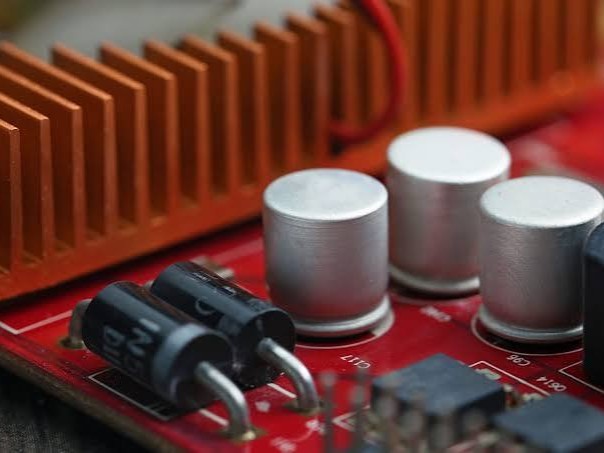 A high voltage capacitor is a capacitor specifically designed to operate under elevated voltage conditions. It stores and releases electrical energy to perform functions such as filtering, energy buffering, resonance, pulse absorption, and voltage stabilization.
High voltage capacitors are available in various structures and technologies, including high voltage MLCCs (Multilayer Ceramic Capacitors), high voltage ceramic capacitors, single-layer ceramic capacitors, and film capacitors.
In practical applications, "high voltage" does not represent a fixed voltage threshold. The classification depends on the capacitor's rated voltage, dielectric technology, and operating environment. For example, TDK provides C0G high voltage MLCCs with rated voltages up to 1,250V, while Vishay’s 715C series high voltage ceramic capacitors cover voltage ratings from 10kVDC up to 50kVDC.
Main Types of High Voltage Capacitors
● High Voltage MLCC
High voltage MLCCs feature compact size, low ESR, excellent frequency characteristics, and high reliability. They are widely used in power filtering, decoupling circuits, automotive electronics, and applications where PCB space is limited.
● High Voltage Ceramic Capacitors
High voltage ceramic capacitors generally use disc or radial-leaded structures and provide excellent insulation performance and high voltage endurance. They are commonly used in high voltage power supplies, X-ray systems, laser equipment, and industrial applications.
For example, Vishay's 715C series is specifically designed for high voltage applications including high voltage power supplies, CO₂ laser systems, and X-ray equipment.
● Film Capacitors
Film capacitors offer advantages including low dielectric loss, excellent stability, and strong pulse-handling capability. WIMA FKP 1 series film capacitors use polypropylene dielectric technology and support voltage ratings up to 6,000VDC, making them suitable for high-frequency and high-pulse applications.
Key Parameters for Selecting High Voltage Capacitors
When selecting a high voltage capacitor, engineers should carefully evaluate the following parameters:
1. Rated Voltage
The capacitor's rated voltage should be higher than the actual operating voltage, while also considering transient voltage spikes and surge conditions.
2. Capacitance Value
Capacitance determines the energy storage capability and filtering performance of the capacitor. The required capacitance depends on the circuit design and application requirements.
3. Dielectric Material
Different dielectric materials provide different characteristics in terms of temperature stability, dielectric loss, voltage stability, and reliability.
4. Operating Frequency
For high-frequency applications, ESR (Equivalent Series Resistance) and ESL (Equivalent Series Inductance) become important factors affecting performance.
5. Temperature Range
Industrial and automotive applications require capacitors with appropriate temperature ratings and long-term reliability under harsh environments.
6. DC Bias Characteristics
High dielectric constant MLCCs may experience capacitance reduction under applied DC voltage due to DC Bias effects. Therefore, the rated capacitance value may not represent the actual capacitance under operating conditions.
7. Mechanical and Insulation Design
High voltage applications require careful consideration of creepage distance, clearance distance, mounting structure, and insulation requirements.
For volume procurement, buyers should additionally confirm the manufacturer, complete MPN, production batch, package type, original specifications, inventory availability, and lead time. If the original component faces supply shortages or extended delivery cycles, replacement solutions should be evaluated based on electrical characteristics and application requirements rather than simply matching capacitance and voltage ratings.
Recommended High Voltage Capacitor Series
The following products are representative high voltage capacitor series widely used for engineering reference and sourcing evaluation. Actual component selection should always be verified according to the complete MPN, capacitance value, tolerance, package, and voltage rating.
Mfr | Series | Type | Typical Voltage | Typical Applications |
TDK | CGA Series | High Voltage MLCC | Up to 1,250V | Automotive electronics, power supplies |
TDK | C Series | High Voltage MLCC | 1,250V, C0G dielectric options | High reliability circuits |
Murata | DE1 Series | Safety Ceramic Capacitor | Up to 1,500VDC | Industrial equipment, solar systems, lighting |
Vishay | HV Series | High Voltage MLCC | Up to 8,000V | High voltage filtering |
Vishay | HVCC Series | High Voltage Ceramic Capacitor | Up to 15,000V | Industrial and medical equipment |
Vishay | 715C..DK Series | High Voltage Ceramic Capacitor | 10–40kVDC | X-ray systems, laser equipment |
Vishay | 715C..KT Series | High Voltage Ceramic Capacitor | Up to 50kVDC | Ultra-high voltage applications |
WIMA | FKP 1 Series | Polypropylene Film Capacitor | 400–6,000VDC | Pulse circuits, high-frequency applications |
These product families are supported by publicly available manufacturer specifications. For example, Murata DE1 series includes safety ceramic capacitors with ratings up to 500VAC/1,500VDC, while Vishay HV series supports voltage ratings up to 8,000V and its 715C series extends into the 10–50kV range.
Typical Applications of High Voltage Capacitors
The value of high voltage capacitors is not only their ability to withstand elevated voltages, but also their capability to maintain stable electrical performance during long-term operation. High-voltage capacitors are widely used in high-voltage power supplies, automotive electronics, industrial frequency converters, power converters, medical X-Ray equipment, laser equipment, and new energy systems.
High voltage MLCCs are ideal for applications requiring compact size and high-frequency performance. Film capacitors are better suited for DC-Link circuits, high-power applications, and pulse environments. Ultra-high voltage ceramic capacitors are commonly used in specialized equipment such as high voltage generators, X-ray systems, and laser devices. For example, WIMA FKP series capacitors are designed for high pulse and high-frequency applications, while Vishay 715C series targets high voltage power supplies, CO₂ lasers, and X-ray equipment.
FAQ
Q1: Is a higher voltage rating always better for a capacitor?
Not necessarily. The voltage rating should match the actual operating conditions, including transient voltage requirements. Selecting an unnecessarily high voltage rating may increase component size, cost, and affect other electrical characteristics.
Q2: Why is the actual capacitance of a high voltage MLCC sometimes lower than the rated value?
Certain high dielectric constant ceramic materials experience DC Bias effects. When DC voltage is applied, the effective capacitance may decrease. Engineers should refer to manufacturer-provided DC Bias characteristic curves during circuit design.
Q3: Can high voltage ceramic capacitors and film capacitors be directly substituted for each other?
No. They cannot be replaced simply based on capacitance and voltage ratings. Differences in ESR, ESL, dielectric loss, pulse capability, size, and temperature characteristics must be evaluated before substitution.
Q4: What information is required when purchasing high voltage capacitors?
For accurate sourcing, customers should provide: Manufacturer, MPN, Capacity, Rated voltage, Tolerance, Medium, Packaging, Quantity and Application environment. Providing complete specifications enables faster confirmation of original components and qualified replacement solutions.
Website: www.conevoelec.com
Email: info@conevoelec.com


